The OCC recently released its report on supposed debanking at some of the nation’s largest banks. Comptroller Jonathan Gould proclaimed that the report “provides irrefutable evidence” that these banks have “denied, debanked, and discriminated against lawful businesses.” Bold words, but do they stand up to scrutiny? We’ll take a closer look at the OCC’s report and evaluate some of its underlying premises.
Shock and Awe
The OCC report begins with a bit of shock and awe. OCC claims to have “reviewed nearly 100,000 complaints, hundreds of individual bank decisions, and about 420,000 pages of bank documents.” This is also known as a “keyword search.” The report itself shows little evidence of a serious, comprehensive review. It was a search for examples to buttress a pre-established case.
What is Debanking?
Good luck finding that out from the report. OCC uses the word “debanking” 62 times without explicitly defining what it means. The closest the report comes to a definition is “limits on the provision of access to financial services to Americans on the basis of their political or religious beliefs or affiliations or lawful business activities.” Of course, “provision of financial services” is a very broad term. If a bank denies a loan or sets limits on lines of credit, are they denying access to financial services? Or is that just loan underwriting?
Rationing of banking services occurs on both sides of the balance sheet. The one-time CEO of ING Direct boasted that the bank sometimes “fired” its depositors if they needed too much handholding. Is denying or closing an account for often well-founded money laundering concerns worse than closing one because customers contacted the call center too often?
Unreliable Narrator
As I noted in an earlier post, the confidential nature of bank supervision can create an unreliable narrator problem where claims can be difficult to verify or falsify. This can be especially problematic when the bank regulator is the unreliable narrator and selectively releases information. The report provided about 20 specific, non-exhaustive debanking examples. For banks with millions of customers, do 20 cases demonstrate that debanking is a systemic problem? Do the cases cited tell the whole story, or do they leave out important facts that could lend context or run counter to the OCC’s preferred narrative?
You might think that with 420,000 pages of bank documents that the OCC could come up with more sympathetic victims. The OCC cites the case of a firearms dealer that requested a bank’s assistance with an initial public offering. The bank did not a apply a blanket restriction on firearms dealers but established internal standards for dealers that limited the use of high-capacity magazines and sales to those under 21. How many ordinary, hard-working Americans expect to walk into a bank and get help with their IPO? While OCC attributed some of the debanking to a lack of risk-based criteria, a policy that draws the line on sales of assault weapons to teenagers strikes me as a risk-based approach.
Although the OCC report stresses the impact of debanking on “average Americans,” the report focuses entirely on debanking for businesses and organizations. OCC didn’t provide any examples of individual customers debanked based on, say, a partisan social media post or party registration. It’s also notable that Rohit Chopra, former head of the Consumer Finance Protection Bureau (CFPB) had also called for tighter rules for account closures, though he focused on individual consumers. Chopra was fired by President Trump in February 2025, and his old agency has been largely dismantled.
Objective Risk-Based Criteria
The report attributes the alleged debanking in part to a lack of “objective, risk-based criteria.” But in the real world, businesses make subjective assessments all the time. There is a big difference between “objective” and “reasonable.”
The OCC report dismisses some of the objective assessments banks did use. A narrowly focused limit on gun sales of high-capacity firearms or to teenagers would be one example. In another case, OCC objected to the use of Center for Medicare and Medicaid Services (CMS) ratings when evaluating home health agencies. A low CMS rating is not dispositive but certainly a red flag. A bank might have good, business reasons for not wanting to deal with a low rated nursing home.
Tobacco companies are another alleged victim of debanking, although the report fails to cite any specific instances. The CDC estimates that tobacco products lead to 480,000 premature deaths in the US per year. (The WHO estimates that smoking causes 8 million deaths worldwide.) Could a bank establish an objective, quantitative standard that it would not do business with an industry that kills more than 400,000 people a year?
The OCC makes eight references the Southern Policy Law Center (SPLC) and its designation of some organizations as hate groups. The SPLC reference is a bit of a dog whistle, especially given the Trump Administration’s legal actions against the organization. To be fair, the SPLC has received criticism for applying the “hate group” label too broadly.
These cases also show the limitations of relying exclusively on “objective” criteria. Suppose the Ku Klux Klan wanted to co-brand a credit card with a national bank. Could the national bank turn down the KKK without being accused of debanking? The national bank could cite the KKK’s designation as a hate group, but that apparently doesn’t count for much.
Conspicuous in their Absence
Conspicuously missing from the OCC’s report is a detailed discussion of crypto and digital assets. Much of the debanking debate centers on the treatment of crypto firms. But the report only makes four passing references to “digital assets” and provides no specific debanking examples for this activity. Despite failing to provide any specific crypto-related examples of debanking, the report does call for “reform” of anti-money laundering laws. These include actions to “further assess the extent to which bank policies implementing money laundering and terrorist financing program requirements have contributed to debanking and will take appropriate action as needed.” Laws and regulations inevitably have their costs and benefits. The OCC seems to be suggesting here that the cost of possibly debanking some crypto activity exceeds the benefit of cutting off the financing of terrorist and criminal activity.
The Reputation Risk Bogeyman
The OCC report lays much of the blame for supposed debanking on reputation risk policies. Indeed, the word “reputation” comes up 185 times in the report. This is hardly surprising, since the report focused almost entirely on debanking examples where reputational concerns could have played a role. But there is also a meaningful difference between a private business making a business decision and a government agency forcing those decisions, especially for partisan reasons.
OCC touts its actions to eliminate reputation risk from supervisory programs, where it went so far as to purge the word “reputation” from policy documents. The previously dominant role of reputation risk in bank supervision is often assumed with little if any supporting evidence. In 2025, OCC removed references to “reputation risk” from its Comptroller’s Handbook and from other regulatory guidance. Provided below is a snippet from the Insider Activities section. The Comptroller’s Handbook includes 90 separate sections dealing with various types of risks and activities. OCC did not eliminate the Handbook section dealing with reputation risk, because they didn’t have one. Reputation risk was one of many considerations OCC used in a bank’s core assessment.
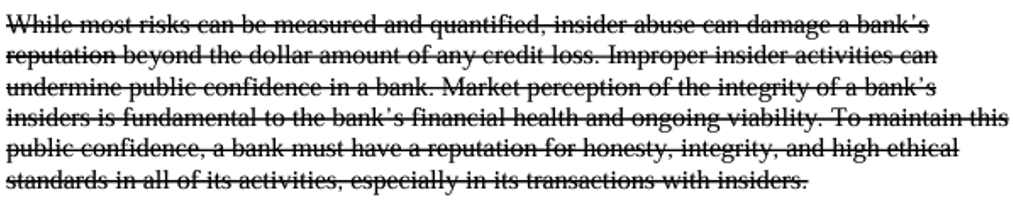
Let’s look at formal enforcement actions, one of the few types of public documents addressing supervision of individual banks. A search of OCC enforcement actions since 2012 shows the word “reputation” coming up 90 times. The vast majority cite reputation among a litany of risks. A typical case would require development of a strategic plan that establish objectives for “a risk profile that evaluates credit, interest rate, liquidity, price, operational, compliance, strategic, and reputation risks in relationship to capital and earnings.” One (USAA) involved ongoing consumer compliance weaknesses and required addition steps for those actions that resulted in “significant reputation risk to the Bank or creates other supervisory concern.” Several involved BSA/AML concerns.
Enforcement actions related to the Wells Fargo sales practices scandal include the most substantive discussion of reputation risk. In this case, the concern was the opposite of debanking. Wells opened accounts that customers never asked for and without their consent. A research paper by McNulty and Akhigbe point out that the impact of the sales practices scandal on Wells Fargo’s reputation “had a much more important effect on stock returns than profitability and loan losses.” To use the mantra among bank regulators today, reputation risk presented a “material financial risk.”
The extent of non-public supervisory actions related to reputation risk is unclear. From my own experience, reputation risk did not appear to be a major driver of supervisory action. OCC has not released any information on matters requiring attention (MRAs) related to reputation risk. The agency could provide some statistics on this without disclosing confidential supervisory information. OCC could simply announce closing X amount of MRAs across the agency that related primarily to reputation risk. The fact that they haven’t suggests that the numbers conflict with the narrative.
The Whipsaw
The OCC makes a valid observation when noting that bank decisions can “whipsaw back and forth with current political climate.” One obvious case involves Citigroup’s Jane Fraser. In 2022, Fraser announced an expansion of “Citi’s diversity representation goals to include additional markets and under-represented groups.” She further proclaimed that “We will continue embedding diverse representation and equity in our business strategy as well as our executive scorecards so that it’s standard practice for our colleagues, clients and customers.” Citi also pledged to be carbon neutral by 2050.
Fraser made a whiplash inducing turnabout when Trump returned to office. She not only reversed carbon, firearms, and DEI policies at Citi but also became especially cosy with Trump himself. A former Citi managing director claims she was fired after raising concerns about taking on Trump as a client. Other banks have also put their fingers to the wind, albeit with a bit more subtlety. These actions raise questions of the sincerity of a bank’s actions and supposed values, either previously or now.
But the OCC undermines its own critique. The OCC places President Trump front and center in the effort to stop debanking. The report includes a huge color photo of Trump signing the debanking Executive Order into law, complete with J.D. Vance and Scott Bessant doing their best Nancy Reagan gaze. The photo also appears at the top of the associated webpage. Both the webpage and the report itself open with the fawning phrase “under President Trump’s leadership.”
Trump makes a less than credible choice as the face of depoliticized finance. He routinely sics the Justice Department, ICE, the Federal Housing Financial Agency, or the FCC on his political enemies. Those enemies can extend to talk show hosts that rub him the wrong way. Having Trump leading the effort to depoliticize finance is like O.J. Simpson leading the search for Nicole Brown’s real killer.
Comptroller Jonathan Gould isn’t very credible in this respect either. I worked under seven presidential administrations and would normally expect agency leadership to reflect a current administration’s priorities. But agency leadership usually tried to maintain some professional distance. Gould is by far the most partisan bank regulator (and that includes those in the first Trump Administration). Speeches, press releases, and social media posts include obsequious shoutouts to the president. Although Gould’s counterpart at the FDIC, Travis Hill, has taken similar policy positions, Hill’s public statements sound more like those of a normal bank regulator.
Irrefutable Evidence?
The OCC report includes the following disclaimer:
The scope of the agency’s observations and conclusions reflect a variety of factors, including the thoroughness of the banks’ responses, the extent of their cooperation, the methods employed by the banks for tracking these matters internally, and the availability of detailed documentation reflecting the contemporaneous reasons for bank decisions. Accordingly, the OCC was unable to quantify on a comprehensive basis the full extent of debanking or alleged debanking actions or the costs to customers and prospective customers across the nine banks.
OCC essentially cobbled together some anecdotes fit their preferred narrative. Did some banks deny financial services to some organizations for illegitimate reasons? Perhaps. Did OCC provide “irrefutable evidence” that this was the case and a widespread problem? Not even close.
Leave a Reply