The results of the 2026 US midterm elections shone a light on some of the limitations in using gerrymandering to gain partisan advantage. A gerrymandering strategy can work well under normal conditions but can fall apart in more extreme cases. Some financial products work the same way. Structured advances, Type 2 PAC bonds, and senior support CMO tranches are three examples.
How Gerrymandering Works
Each US state gets two senators, but the number of representatives depends on the state’s population, as indicated by the ten-year Census. The House of Representatives has 435 members, which works out to about 760,000 people per congressional district. Since congressional districts can’t cross state lines and each state gets at least one representative, there can be considerable variation for less populous states. For example, Wyoming, with a 2020 population of 576,000 gets one House seat. But so does Delaware, with a population of 990,000.
States have wide latitude in drawing up Congressional maps. This has given rise to gerrymandering, where the districts are designed to advantage a particular politician, constituency, or political party. Gerrymandering is not new. It’s named after Elbridge Gerry, a political leader who died more that 200 years ago. Use of gerrymandering to gain partisan advantage has become more prominent in recent years.

Consider the gerrymandering example above. A state has six Congressional districts and historically, the overall vote is 53% for Republicans and 47% for Democrats (or R+6). The Congressional map could be drawn in a way to have four districts R+16 partisan split and two with D+16 partisan shift. The result would be four Republicans and two Democrats. But suppose the state legislature decided to redraw the lines to change the two D+16 districts to R+2 or R+3. But there’s a catch. The redistricting doesn’t change the total number of votes for Democrats or for Republicans. The additional Republicans must come from somewhere. In this case, it would be by reducing the Republican majorities in the R+16 districts to 53% (R+6). Still, in a normal election, Republicans would now be favored to win all six seats.
How Gerrymandering Can Go Wrong
The key qualifier here is a “normal election.” If the Democrats outperform by, say ten percentage points, then the state Congressional delegation goes from six Republicans to six Democrats. Republicans would have maintained the 4-2 edge if they had maintained the pre-redistricting map.
Whether and to what extent gerrymandering efforts hurt the Republicans in 2026 is hard to say. Approaches could vary from state to state, and some gerrymanders may have prevented even bigger blowouts. Judicial actions blocked some efforts and Democrats responded tit for tat in blue states, like California. It certainly wasn’t the panacea that some of its advocates expected.
Financial Products
The big limitation with gerrymandering is that there are only so many votes to go around. Manipulating the election map can give you an edge, but that edge can disappear and even backfire in more extreme scenarios. Some financial products can be designed to perform well under normal conditions. But you are only rearranging the risk, not eliminating or even reducing it. Three prominent examples are structured advances, Type 2 PACs, and mezzanine tranches of non-agency CMOs.
Structured Advances
Federal Home Loan Banks (FHLBs) offer advances to their member banks. These advances can be either short or long term. During the early 2000s, the FHLBs started tooffer structured advances. The borrowing could be either short or long term, at the discretion of the FHLB. One extreme, but not unusual example was the 10/1 advance. The loan went out 10 years but guaranteed a fixed rate for only one year. After one year, the FHLB could put back the loan or convert it to a floating rate. This would only happen if market rates went up and the borrower would need to finance at a new, higher rate. If rates fell, the fixed rate borrowing would remain in effect. The borrower would be stuck with above-market financing for the next ten years.
Structured advances offered a lower rate than a standard fixed rate borrowing. In a stable rate environment, structured advances could tamp down interest expense. But they proved disastrous if market interest rates went up or went down sharply. Although FHLBs were ostensibly created to encourage mortgage finance, structured advances proved an especially poor fit for banks with large concentrations of residential mortgages or MBS. US mortgages have an embedded option that allows borrowers to prepay their mortgages. If rates go up, the mortgages extend while the advances prepay. If rates go down, the mortgages prepay and the advances extend. The borrowing bank loses if there is volatility in either direction.
Type 2 PACs
The collateralized mortgage obligation (CMO) is a way to redistribute mortgage cash flows. The embedded prepayment option makes mortgage cash flows unpredictable. A CMO has essentially the same underlying cash flows as the underlying mortgages but can rearrange those cash flows into different classes or tranches. One way to make cash flows more predictable was to create planned amortization class (PAC) tranches. PACs would behave more like a traditional bond. If its weighted average life was supposed to be five years, it would remain at five years under a wide range of interest rate scenarios. But again, the prepayment risk doesn’t go away. Instead, another tranche, called a support tranche, would absorb the prepayment risk. In other words, PACs had less prepayment volatility than the underlying mortgages, but support tranches had more.
The Type 2 PAC was a popular variation. It offered a better yield than regular PAC bonds and would continue to offer stable cash flows for moderate changes in rates and prepayments. The catch was that once prepayment fell outside a pre-established band, the PAC 2 would act like a support bond. Weighted average lives could swing radically and a seemingly low risk bond could quickly become high risk.
Senior Support Tranches
During the 1990s, government sponsored enterprises (GSEs) like Fannie Mae and Freddie Mac issued the vast majority of CMOs.. Starting in the 2000s, however, non-agency mortgage securities became more popular. Non-agency MBS also had a tranche structure, but the focus was more on credit risk than interest rate risk. That meant that non-agency structures consisted of junior (first loss) and senior (last loss) tranches. There were also mezzanine tranches that fell somewhere in-between. The mezzanine tranches, euphemistically referred to as “senior support” tranches, often carried AAA credit ratings, at least prior to the Global Financial Crisis (GFC). The catch with senior support tranches was that once the junior tranches were wiped out, the mezzanine tranches functioned just like junior tranches and absorbed a higher proportion of credit losses than the underlying collateral.
Consider the following (simplified) example, shown below. The senior support tranche has an attachment point (the loss rate on the underlying collateral where it begins to absorb losses) of five percent. It also has a detachment point (the loss rate on the underlying that wipes out the tranche) of ten percent.
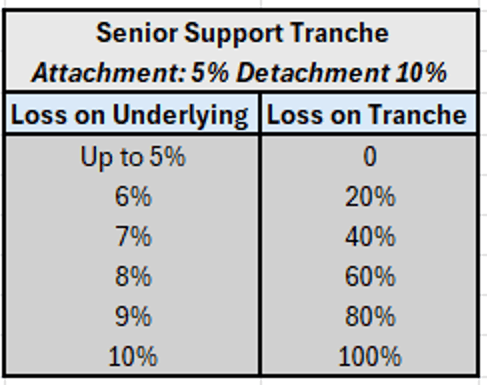
The risk profile of senior support tranches has enormous cliff edge effects. If losses on the underlying mortgages are 5% or less, the senior support tranche sees no credit losses. But once the underlying loss goes above 5%, losses accelerate rapidly. For every one percentage point additional loss on the underlying collateral, the loss rate on the senior support tranche increases by twenty percentage points. The losses wouldn’t be quite that bad in practice, since the support tranche might still receive some cash flows before it gets wiped out. At the same time, attachment/detachment points of 5/10 respectively were hardly the worst we saw during the GFC. I remember cases of AAA securities where the attachment points were 4%, and the detachment points were 5%. As one of my colleagues said at the time, “it’s a small hole but a deep one.”
The Plausibility Trap
Both gerrymandering efforts and the financial products discussed above fell into what I’ve called a plausibility trap. Partisan divides in the United States have remained quite stable over the years. While an R+3 or a D+2 year is easy to imagine, the D+13 popular vote margin that we saw in 2026 hadn’t happened for either party in more than half a century. A strategy that works well with a close overall vote can fall apart under more extreme conditions.
This is even more true for some of the financial products. Historical default rates on AAA rated securities were very close to zero (and still are for corporate bonds, though not for structured debt). Those who purchased AAA senior support tranches just didn’t see losses on these securities as very plausible. That turned out to be a grave miscalculation.
Nonlinear risk profiles can compound the problem. Senior support tranches were much safer than the underlying mortgages under benign and even moderately adverse scenarios. But in the severe 2008 scenario, they turned out to be much, much worse. The swing from gerrymandering, at least on a national level, was more moderate. Prior to the 2026 election, analysts estimated that gerrymandering gave the Republicans a four-point cushion. In other words, they could retain the House for up to a D+4 environment. The actual Democratic voting edge was +13, but Democrats look to have a 20-percentage point House majority. Gerrymandering didn’t seem to help but, at least at a national level, did not have huge cliff effects. Well, maybe it did in North Carolina.
This Time is Different?
Do investors now appreciate some of the pitfalls with the types of financial products discussed above? Probably to some extent. Structured advances are still available but have become much less popular. The private label RMBS market has never fully come back from the GFC.
Still, investors continue to purchase securities with similar pitfalls. Mezzanine financing remains a popular feature for commercial mortgage-backed securities (CMBS). Or consider credit risk transfers (CRTs) for GSEs. The idea is to move some GSE and US taxpayer exposure to private investors by issuing CMOs. Some of these CMO tranches still carry investment grade ratings. Consider the Class A-1 notes for Freddie Mac STACR 2026-DNA1. The tranche is rated A+ but with an attachment point of 3.525% and a detachment point of 4.80%. The security can go from seemingly safe to toxic in very quick order. Maybe this time is not so different after all.
Leave a Reply